 |
| Is she smiling at me?! |
Let me start by saying that this was an incredibly short (3
day) trip to Egypt, which was enough time to see pyramids but way too short a time
to explore the country’s great diving sights or cruise down the Nile to the
Valley of the Kings. As Egypt is in a
state of flux we needed special work permission to travel there and figured a
short trip would have a better chance of being approved. Chris managed the maze of red tape and we
were thrilled to be able to go!
Why Egypt? The
Pyramids of Giza (and others), of course.
They’re 4500 years old and the only Ancient Wonder of the World still
standing. Neither of us ever thought
we’d be able to see them in person! It never seemed like a viable trip from the
States and even from here it’s an expensive 4 ½ -hour flight to Cairo.
This was not our smoothest trip to date. A half-hour before the flight was scheduled
to leave we had an ‘oh crap’ moment (our flight wasn’t listed on the
departures) that the EgyptAir flight we were taking was actually a code-share
with British Midlands, which left not from where we were standing at Heathrow’s
Terminal 3, but about a mile away at Terminal 1. I always laugh at people running through an
airport but then say a prayer that they’ll get where they need to be. I think others do the same, because we
somehow made it and got to our boarding gate nice and sweaty but with whole
minutes to spare. I had to confront my
own stereotypes and overcome anxiety by getting on a plane where the majority
of women were in burkas or headscarves, and men were looking at us like we were suspicious. I was more self conscious than I’ve been in a
while!
So yes, we landed safely in hot, sunny Cairo. The second ‘oh crap’ moment was having only
enough cash to buy one (we needed two) of the tourist
visas needed to get through customs. We
knew we’d have to buy the visas, so it was totally our fault, but we weren’t helped when the
two ATMs were both out of order. It was
an ordeal: Chris bought his visa and went through customs, found a working ATM
in the main airport lobby, made his way back to customs and handed me money so I
could buy my visa and finally make it through customs. Everything worked out in the end but it was stressful enough to
warrant a new Travel Rule: Carry More Cash.
The first Egypt Challenge was surviving the hour cab ride to
the hotel. You think I’m kidding? 22
million people live in Cairo, with 3 million more commuting each day. The only way to describe the gridlock is
organized chaos, emphasis on chaos. First of all, it was incredibly loud. Drivers use different taps of the horn to
mean ‘I’m next to you’ or ‘I’ll ram you before I let you in front of me’ or ‘go
ahead, but I’m not happy about it’ or ‘I’m turning’. Drivers weave around tuk tuks, slower cars, bikes,
mopeds, donkeys, and people, and there aren’t any road markings to go by even
if you were remotely interested in staying in a ‘lane’. The number of lanes in
a particular road is completely dependent on the aggressiveness of the drivers
and size of vehicles present. On the
drive to the hotel we passed through the Cairo suburb Heliopolis, home to many
previous presidents’ residences including former president Mubarak’s estate.
For a few miles we
were alongside a wedding party crammed into a group of cars, all of which were
blasting their stereos and honking horns to the beat of the music.
The people within were celebrating by shouting, clapping, and singing. They
were straight up having a road party and invited us to join in on the clapping
(remember, we’re maybe six inches from cars in the ‘lanes’ next to us… eye
contact was inevitable) and our taxi driver honked right along with them.
We weren’t two hours
into our trip and my senses were overwhelmed by the heat, smells (not terrible,
just different), noises, traffic, sights, sun, jarring car movements, and
dust. The sun was setting and the seemingly hundreds
of minarets and tall buildings were backlit by the dusty orange sky for most of
the drive. That part was gorgeous,
despite the dilapidated, crumbling concrete with rebar sticking out that made
up most of the endless mass of gray and brown buildings. Cairo is vibrant but
also big, old, and dirty.
 |
| Being on the road was an adventure in and of itself. |
We were dropped at our hotel, located in a quiet part of the
city. We had read all about baksheesh
(tip/alms/payment for favors) and were ready with our small notes and
coins. Although advanced in some ways,
Egypt is still a Third World country. Most
people depend on baksheesh to supplement their minimal wage. We had budgeted for that and okay with the
system, but nothing prepares you for the awkwardness of tipping in an
unfamiliar place. In fact, tipping never
fails to be our top anxiety producer while traveling. Each country has different customs on
tipping, from when to how much to physically how to hand it over. Do you tip everyone who gives you advice or
provides a service? Is it better coming
from Chris or me? Have to be from the
right hand? With a smile or a nod? Left discretely or given assertively? Too little can be offensive, but too much is
often just as offensive (unlike in the States were the more the better,
right?!) In some countries you round up
to the next whole dollar, so a 13.55 bar tab becomes 14, but some would expect
20% for even mediocre service. Get where
I’m going with this? Most trips involve at least one awkward tipping moment,
and this one didn’t disappoint. I
appreciate the Egyptian tendency to respond and deflect awkwardness through
humor. My tactic this time around was to
beg Chris to hold our money and deal with all the exchanges. Hehe.
There were awkward moments aplenty, actually. Within five minutes of check-in we couldn’t
figure out how to pour the Arabic coffee in the hotel lobby (an attendant saw
us struggling and came over to help and then we tipped him but he looked
surprised to be given money so that was awkward, too), then weren’t sure if we
should just drink it as a shot (it’s poured into a tiny glass cup) or sit down and
sip or what, so we just stood in the lobby looking conspicuously Caucasian. I took it as one sip but it was too hot for
Chris so we had to stand there for minutes that felt like hours. Not kidding, we retreated to the room with the glass in hand! We were overwhelmed and tired to the point of
ordering room service pizza and watching Paralympics until bedtime.
A fantastic buffet breakfast at our hotel the next morning charged
us up enough to brave an expedition into the streets to buy a couple bottles of
water as we waited for our tour guide to meet us in the hotel lobby. We do most trips independently but felt that a
guide would be a better option in Egypt (and for us, it definitely was.) We booked with a company called Memphis
Tours because of good reviews on TripAdvisor and were extraordinarily happy
with the guide they assigned us named Shaimaa, who was a bubbly, sharp, 27-year
old working on her masters in Egyptology at Cairo University.
Having Shaimaa and our driver allowed us not just see, but understand more in two days than we could’ve experienced in a week
by ourselves. The luxury of an
ever-waiting air conditioned vehicle made our trip pleasant as well as
efficient. We were also spared a lot of
hassle from unwanted sales pitches and Shaimaa told us when and where to tip,
saving us money and eliminating that anxiety.
After we exchanged hellos and handshakes, Shaimaa rattled to
our driver that we were going first to the Great Pyramids and then turned to us
with a huge smile and started Shaimaa-ing… that is, speaking excitedly in
almost perfect California English (which makes sense, she learned English from watching George Clooney movies
over and over again.) She also taught us
a key Arabic phrase, “Insha’Allah” which means “God willing” but is used
for anything in the future tense. For
example: We’ll go to the Cairo museum
tomorrow, Insha’Allah. If the person
speaking forgets to say it, the person they’re speaking to will say it for
them, almost reflexively. Once we
understood it as a phrase we heard it everywhere, seemingly always!
Chris and my first impression of the Pyramids was “What?!
These are straight up in Cairo! “
We had driven maybe half an hour through nutso traffic and
suddenly, seemingly in the midst of the city (actually in the city of Giza which
abuts Cairo), the tops of the familiar pyramids popped out from behind
buildings. The pyramids are actually on
a plateau but seriously, all the photos make them look like they’re in the
middle of the desert when in fact the plateau is surrounded on three sides by buildings. We got to the pyramids around 9:00 and were
two of maybe ten tourists on the entire plateau. Shaimaa’s
constant, bubbly stream of information was invaluable. She had us picturing what the pyramids
would’ve looked like more than 3500 years ago and provided great information
about Egypt at that time. After we got
the back story, Shaimaa pointed at the Great Pyramid and exclaimed, “Well go
ahead, touch it!”
 |
| Sitting on the corner stone of the Great Pyramid of Keops. |
 |
| Ya know, just sitting on a pyramid. |
 |
| Shaimaa excitedly showing Chris something or other. |
 |
| Another bonus of having a guide: being together in photos! |
 |
| Awesome!!!! |
We wanted to ride a camel, so Shaimaa bargained with a kid
holding two of them and we hopped on for a half-hour ride. This touristy thing was so worth the $20/each
to do. Getting on a camel is easy – it lays down and you just swing your leg
over. The hard part is not looking like
an idiot when the camel stands up. The boy
told Chris to lean back and the camel lifted itself to its front knees, then
stood its back legs completely up, then straightened its front legs. It was like
being on an exaggerated and very slow rocking horse. So yep, we were up. Our camels were led around to a good photo op
location where the 12-year old kid leading us took a bunch of photos and an old
guy with a mule offered to sell us a coke.
Tourism took a HUGE hit from the revolution last winter. The industry once brought in a quarter of the
country’s economy but has been down an estimated 75% this year. That said, we didn’t want to buy things from
everyone. I have some remorse and
sadness now, though. I should’ve just
bought the coke for 50¢. Anyway, we got
the photos we had dreamt about – on a camel in front of the Pyramids.
 |
| Lean back, Chris! |
 |
| I can't believe we're on camels! |
 |
| Gotta do it. |
 |
| They look unsure about each other. |
After exploring the Great Pyramids we drove to the other
side of the plateau to see the Sphinx. This
huge half man/half lion guards over the plateau. He’s lost his fake beard (According to Shaimaa,
“only our enemies have beards - Egyptian men shave theirs”), nose, and some of
his headdress but otherwise is in fantastic shape. Apparently Napoleon and his French army used
his head for target practice in 1798 when they ruled the area for those couple
years.
 |
| The Great Sphinx of Giza. |
 |
| Riding in the back of the truck with six camels. Don't see that everyday... |
Shaimaa advised us not to spend the $18/each to go inside
the Great Pyramid and instead took us to another site where we spent a few
bucks to go inside a pyramid that looked almost like a pile of rubble. We climbed down the steep, cramped stairs
with a flashlight-wielding guide until the passageway opened into two small rooms
– one with a tomb and the other empty where food and supplies would’ve been
left for the dead person. Perfectly
preserved 2800-year old hieroglyphics covered
the granite walls and the ceilings were carved with stars. A part of one wall had been restored but
otherwise the guts of this pyramid were completely intact. So cool.
We were surprised that the pyramids are completely solid except for the
few very small rooms at the base for the body and whatever other supplies the
person may need in the afterlife.
 |
| That pile of rubble is in fact a pyramid. |
 |
| Going down into the depths. |
 |
| Ancient heiroglyphics everywhere. |
We stopped in a government-run papyrus store before lunch. I was skeptical at first, but was glad to have
a little showing of how papyrus paper is made in a semi-professional setting
and then being able to wander in peace for half an hour looking at all the
designs for sale. We did buy a painting
as souvenir and am happy we did. After
lunch we went to see Memphis, the ancient capitol of Lower Egypt (as in, ‘lower
Nile’, or northern Egypt) founded in 3000BC.
There isn’t much left of Memphis except for a couple huge statues of
Rameses II. We bought a camel hair
tapestry for next to nothing as our second souvenir.
 |
| Rameses II has a big head. |
The last stop of the day was the Step Pyramid of Zoser,
built in 2800 BC. It’s incredibly
important in human history as it’s the oldest stone building built by man and was
the prototype of pyramids. The whole
family is buried in pyramids close to each other: Granddad has Zoser, his son
Khufu (aka Keops) has the largest of the three Great Pyramids of Giza, grandson
Khafre has the second-largest one that is built on higher land so looks the
tallest, and great-grandson Menkaure has the smallest of the three (it’s
thought that power or money was fading by that point). Their wives have tiny little pyramids next to
them. From a vantage point along the far
side of the Step Pyramid we could see fourteen
pyramids of various sizes and levels of decay.
I was fascinated that they just discovered another pyramid nine weeks
ago in the area, and it’s neat to see all the archeology tents around knowing
that discoveries are still being made.
 |
| Archeology work continues on the site. |
 |
| Step pyramid of Zoser. |
We asked to be dropped off at the Four Seasons in Cairo,
where we wanted to have a coffee before taking a Nile boat cruise. Shaimaa was happy with that! It was interesting that although we come from
completely different worlds, she and I were similar in many ways. She was going out for dinner with friends
after our tour, so the both of us used the posh Four Seasons bathroom to wash faces,
re-do hair (which she then covered with a gorgeous silk scarf), powder faces,
apply eyeliner and mascara, and generally be girly. Shaimaa talked about her many like-minded girl
friends from school, all of whom were studying Egyptology or tourism, and how
she had no friends from her old neighborhood.
She talked about liking Mubarak “he did many great things for us in the
first ten years he was in office” until he
released all the prisoners from prison to cause chaos as backlash for being
ousted. According to her, the
streets that had always been safe were suddenly unsafe, and a two-month long
4:00 PM mandatory curfew was enacted.
“We didn’t even know what that word meant in Arabic, let alone know it
in English!” Shaimaa said the streets were violent for a while, a rarity
because “religion guides us to be peaceful here.” She said “the army saved us.” It set up a deal whereby prisoners returning
on their own will would get their sentences halved while prisoners who were
caught by the army would have their sentences doubled. Most returned on their own accord and curfew
was dropped.
Shaimaa left to meet her friends and we had a really
relaxing evening culminating in an ulcer-inducing taxi ride that night. It started with a couple hours in the
luxurious and air-conditioned lobby of the Four Seasons sipping coffee (Arabic
for me, American for Chris – still don’t know if I was supposed to finish the
entire urn of coffee they brought).
There was a 20-second spike in heart rate from having to cross the road
to get to the waterside, but then another hour of calm as we were sailed up and
down the Nile for an hour in a felluca.
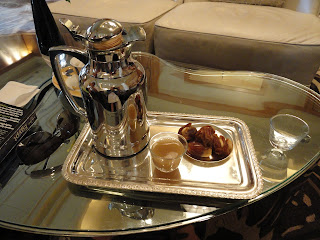 |
| Arabic coffee and dates at the Four Seasons. |
 |
| Fellucas ready to go for a sail on the Nile. |
 |
| Nile sunset cruise on the felluca. Very peaceful! |
We returned at dusk and walked across the 26 July Bridge
that goes from one side of the Nile to the other, stopping over at a large
island in the middle that houses some of the fancier homes and embassies in a
neighborhood called Zamalek. I had
followed advice to wear long, loose trousers and to cover my arms to at least
elbows so as not to attract any bad attention, and this was the first time I
felt remotely uncomfortable not wearing a headscarf. It was a nasty feeling to
be on the opposite side of it.
 |
| A mineret lit at dusk. The calls to prayer are played through loudspeakers from hundreds of the city's minerets. |
 |
| Party boats on the Nile (without many people in them.) |
The taxi ride home was a little terrifying. I think we were just on high alert, but our
cabbie started off in the opposite direction than we knew our hotel to be in
and then wouldn’t immediately turn around.
I was coming up with a worst case scenario (he’s taking us hostage!) and
told Chris I’d jump out of the (moving) car if we didn’t turn the correct
direction in the next two minutes.
Thankfully for me and the mental well being of the cab driver I stayed
in the car (no seat belts offered, of course).
He turned around eventually, muttering something about traffic. Turns out he was probably just trying to milk
us for a higher fare.
We were picked up at 7:30AM the next morning and went
directly to the Mosque of Mohammad Ali on the Saladin Citadel which is high on
a hill in the center of Cairo. From
there we went to the Al Rifa’i Mosque which was built in the 1800’s. When we told Shaimaa it was the first time we
had been in mosques she started showing us exactly what happened where and how
she prays. It felt sacrilegious watching
her for some reason, but she found my discomfort sort of comical. We talked about Ramadan and how its purpose
is to teach people what it actually is to be hungry and thirsty so one is more
apt to understand poverty and give to those in need. Shaimaa still guides all-day tours during
Ramadan when she isn’t able to eat or drink from sunrise until sundown, and
said that this year was especially tough because Ramadan fell during the heat
of August. I have to admit I WAS really
curious, and after she reassured that we weren’t intruding was glad to have the
opportunity to talk freely with her about her religion. Shaimaa is Sunni as is 90% of Egypt. I know one person can’t represent an entire
region, religion, or group but she’s truly a great face of the Muslim community
I had previously known very little about (and only heard the negative about in
news.)
 |
| Mosque of Mohammed Ali. |
 |
| Mosque of Mohammed Ali. |
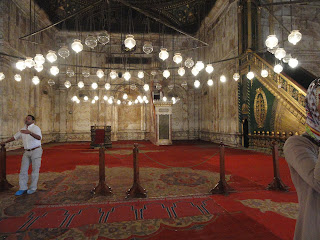 |
| Inside the Mosque of Mohammed Ali. |
 |
| Inside the Al Rifa'i Mosque. |
I mentioned to Shaimaa that I’d like to buy some local
spices, so she and our driver animatedly discussed where to buy some. This is
where having a personalized tour comes in most handy. Chris and I just sat back and tried not to
yelp as we drove down an impossibly narrow road into a lively neighborhood
bazaar and wound up at the most amazing shop full of tiny bins heaped with
various spices. It was crazy in there.
Women were ordering their weekly spices and men with cell phones and lists were
trying to read their wives’ handwriting.
Awesome! Shaimaa took over, thank
goodness, and ordered me a quarter kilo (like a quart bag full) of six
different spices and spice mixes. My
favorites are the ground mixed spices that she translated and labeled simply
“fish”, “chicken”, and “meat”. $12 total.
Awesome!
 |
| Spice shop! |
 |
| Spice shop! |
 |
| Egyptian Museum. |
From there we went to the famous Egyptian Museum. Unfortunately, cameras weren’t
allowed in. The first artifact we saw was the oldest handmade object in the
world. It was a breastplate from 2800 BC
that inscribed with hieroglyphics of the story of the unification of Egypt. Amongst many other artifacts, there were tons
of mummies (of crocodiles, cats, and fish as well as people), thousands of
statues, and a collection of gold jewelry that I absolutely drooled over. The most amazing exhibit for me, though, was
the King Tut collection. It contained
almost everything from the 1920 discovery intact and in one place, and was
absolutely magnificent and priceless.
Shaimaa was great at zipping right to the most interesting of artifacts
and reinforcing dates and knowledge and showing us how everything is
interconnected. I learned more in a
weekend than I would have in a semester at university.
 |
|
After lunch of a
chickpea/lentil/pasta/rice/tomato/lemon/fried onion mash-up we had some black tea
with mint and then made our way back to the airport to recover from a three-day
sensory overload. I’m so thankful we were able to go and have
our eyes opened about a unique, history-rich culture and wish the Egyptians all
the best in the years to come as face a challenging future.


